
In the world of high-value asset allocation, transparency is a spectrum. On one end sits luxury residential real estate—a market where transaction data is practically public property. On the other end lies the ultra-private universe of business and private aviation, where the true purchase price of a multi-million-dollar aircraft is guarded like a state secret. For a family office or a newly minted Gen Z billionaire, this data disparity can be jarring. While your new Malibu compound’s price tag will be splashed across real estate blogs within days of closing, your acquisition of a new Gulfstream G700 or Global 8000 will remain wrapped in an unbreakable shroud of non-disclosure agreements and corporate shells. Understanding this fundamental divide reveals a fascinating contrast in regulation, motivation, and why the sky demands a premium on absolute privacy.
The Real Estate Fishbowl
When a luxury property changes hands, the sale price becomes part of the public record almost immediately. This transparency is driven by legal mandates and structural necessities. Local governments require the recording of deeds and transfer taxes, which are calculated directly from the final purchase price. Municipalities rely on this data to assess property taxes, and the broader market depends on it to establish “comps”—comparable sales that appraisers, lenders, and wealth managers use to value future listings.
Even when high-net-worth individuals utilize Limited Liability Companies (LLCs) or blind trusts to obscure their names from property deeds, the dollar amount itself remains exposed. In real estate, the asset is physically anchored to a municipality. It is subject to local transparency laws that prioritize civic accountability and tax tracking, meaning your real estate portfolio is always, to some degree, on public display.
The Bizjet Black Box
In stark contrast, the private jet market operates in near-total opacity. When a private aircraft is bought or sold, the actual transaction price is almost never made public. This secrecy is systemic, intentional, and entirely legal.
Unlike real estate, the Federal Aviation Administration (FAA) registry—and its equivalents worldwide—cares deeply about who owns and operates an aircraft for safety and regulatory reasons, but it cares nothing about the commercial terms of the transaction. The bill of sale submitted to regulatory bodies lists the aircraft’s chain of title, but the financial details are kept strictly between the buyer, the seller, and their intermediaries…see the official FAA BoS form below (an “850” in industry-speak)
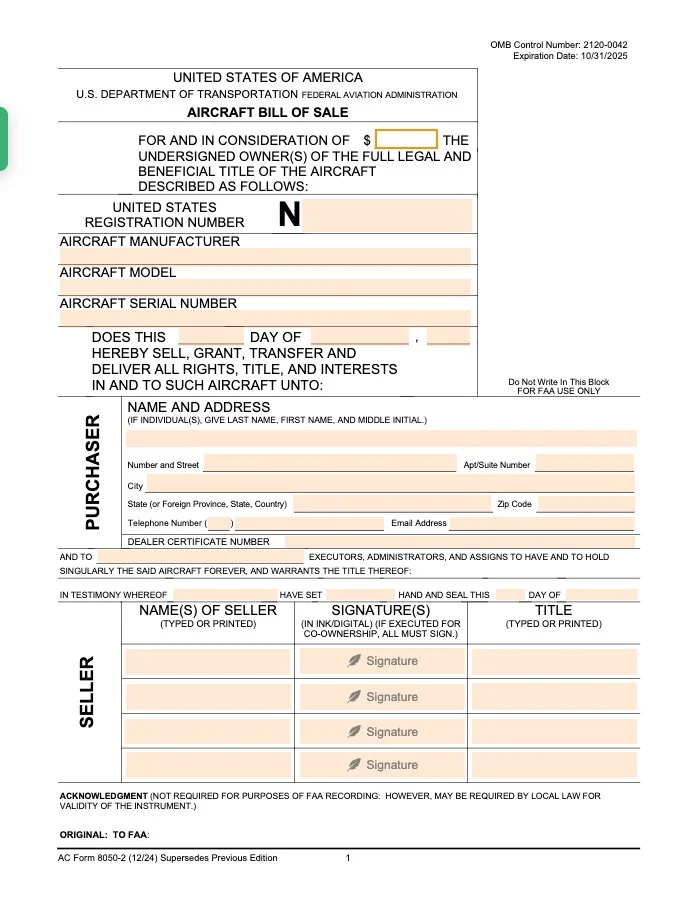
In the $ box, the price is ALWAYS written as ONE DOLLAR + OVC….(”OTHER VARIOUS CONSIDERATIONS”)
The mechanism that enables this privacy is the universal application of strict Non-Disclosure Agreements (NDAs). Every party involved in a jet transaction—brokers, lawyers, escrow agents, and pilots—is bound by confidentiality clauses. To further obscure transactions, aircraft are routinely registered to special-purpose LLCs, owner-trusts (frequently managed by specialized banks in states like Utah), or offshore entities. While an industry insider might know that a certain tail number changed hands, discovering the exact number on the wire transfer is nearly impossible for outsiders. Hence key players on the “inside” can benefit their clients who might be in the hunt for a bizjet acquisition or conversely, a beneficial sale.
Why the Bizjet Market Demands Silence
The motivations driving the secrecy of aircraft pricing are vastly different from the dynamics governing real property, rooted heavily in corporate strategy and future leverage.
First, private jets are highly liquid, mobile, and (sometimes) depreciating corporate or personal assets. If a family office or a public company’s exact purchase price for a corporate jet were disclosed, it could trigger unnecessary scrutiny from shareholders or expose competitive operational movements. Furthermore, revealing the sale price harms the owner’s future leverage. If a buyer knows exactly what the current owner paid for a jet two years prior, it severely compromises that owner’s bargaining position when they decide to upgrade.
Second, the private jet market is remarkably small and clubby. Because there are only a finite number of long-range business jets in existence, a visible price trend can instantly disrupt the residual value of an entire fleet. Aircraft manufacturers (OEMs) like Bombardier, Gulfstream, and Dassault are equally fiercely protective of their pricing. They routinely offer steep, highly customized discounts to fleet buyers or loyal customers. If these actual transaction prices leaked, it would destroy the manufacturer’s pricing integrity and spark outrage among other buyers who paid closer to retail sticker price.
Valuing the Invisible
How does a market function when nobody knows what anything actually costs? In real estate, pricing is democratic; anyone can look at local comps. In aviation, pricing is an asymmetric game of insider knowledge.
The private jet industry relies on a tight-knit network of boutique brokers and consultants, such as Aviatrade Inc. These professionals spend their days making calls, tracking tail numbers, and trading anonymous data points to synthesize estimated market values. They rely on “whisper prices” rather than published data. A family office advisor might know that a recent model sold “in the low twenties” of millions, but the precise decimal points remain a secret shared only by the bank, the escrow house and a privileged peer group of brokers and consultants.
Ultimately, the divide between real estate and aviation pricing comes down to the nature of the asset itself. Real estate is public by geography and civic design—a house belongs to a community. A private jet, however, is a vessel designed specifically to bypass the limitations of geography and public scrutiny. For the next generation of wealth, navigating this black box requires trusting a tight circle of specialized experts, because in the sky, privacy isn’t just an amenity—it is the entire product.
Hence, Aviatrade offers its forty years of accumulated expertise for the benefit of the uninitiated !